Technology Leadership • Digital Transformation • Strategic IT Insights

Why Digital Transformation Fails Without Leadership Alignment
Exploring the critical role of leadership alignment in digital transformation and why technology alone cannot guarantee organizational success.
INSIGHTS
By Shampave Paramanantham | Associate Tech Lead | MBA | DBA Researcher | fCMgr (CMI) | MBCS
5/8/20242 min read

Executive Summary:
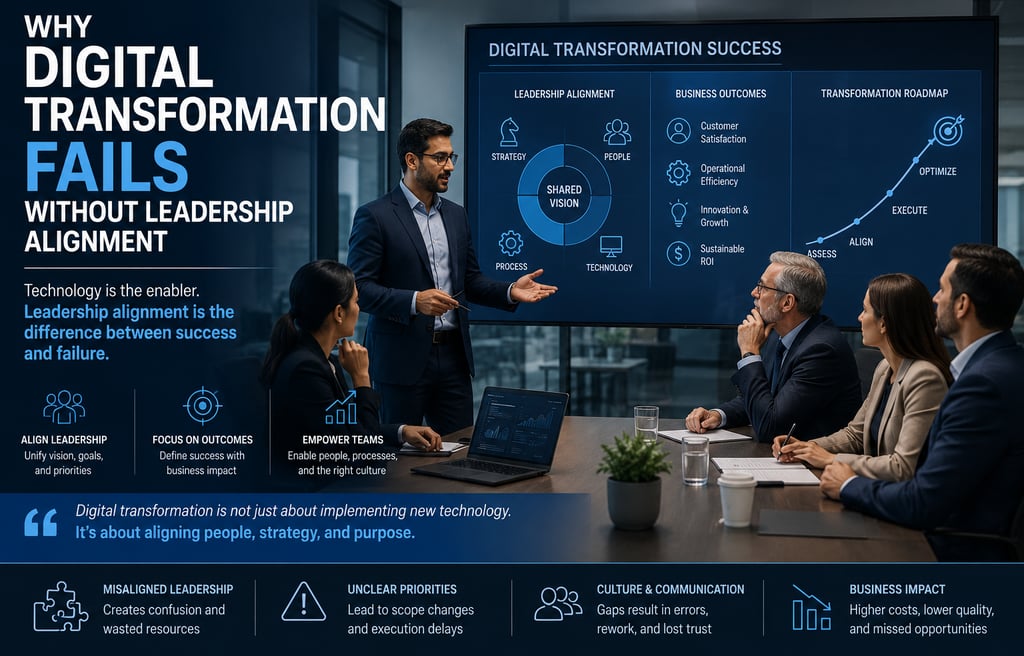
This isn't an IT project or a digital transformation; it is a new business. If your executive leadership fails to align on strategy, the resulting confusion downstream translates into systemic failures in human judgment and execution within engineering teams, leading to poor product quality and reduced corporate ROI.
Just type "Digital Transformation" in any business mag and you will find a never-ending list of buzzwords: Cloud migration, AI integration, agile frameworks, data lakehouses.
However, studies conducted in industry consistently reveal a harsh reality: approximately 66%-70% of digital transformation efforts fail to meet their intended objectives.
Executive boards virtually always blame the technology when these projects go wrong. This is often due to software vendors, the development team, or the code's complexity. Having worked across both software engineering and technology leadership perspectives, I have found that technology itself is rarely the primary cause of transformation failure. More often, the root cause lies in a lack of leadership alignment.
The Executive-to-Engineer Disconnect
If top management is not completely aligned on why a technology change is happening and how success will be measured, toxic ripples will spread throughout the organization.
Without a leadership vision, engineers are left to interpret their own. What this amounts to in practice is precisely the kind of human error I identified and analyzed in my research, which was published through the International Journal of Information Systems and Social Change (IJISSC):
Strategic Blindness Creates Design Errors: When leadership teams are not aligned on organizational objectives, architects and development teams are often forced to make assumptions. These assumptions can lead to design decisions that become expensive and difficult to correct later.
Changing Scopes Drive Skill-Based Slips: Misaligned leadership leads to constantly shifting priorities mid-sprint. When developers are constantly forced to rush code to hit moving targets, cognitive overload sets in, directly triggering execution and coding slips.
Siloed Leadership Crushes QA Quality: If the executive tier prioritizes speed while middle management prioritizes stability, testing teams are squeezed in the middle. Quality assurance gets rushed, allowing catastrophic bugs to slip into production.
Real Transformation Requires Culture, Not Just Code
Digital transformation is about rewriting a company's operational DNA. When the leadership team operates like a set of independent silos, this is exactly how their technology will break.
Real technology leadership entails recognizing that software cannot solve a management problem. Leaders must get aligned on what comes before investing in expensive new database architectures or modern tech stacks:
Business Metric: Are you doing this to lower your operating costs, get to market quicker, or bolster customer retention?
The Human Factor: What are we doing to train, support, and shield our technical teams from burnout and cognitive overload that lead to system-failing human errors?
This perspective is supported by findings from my research involving 365 software professionals and experienced project managers, which examined how human factors influence software delivery and organizational performance.