Technology Leadership • Digital Transformation • Strategic IT Insights

Skill-Based Errors vs. Design Errors: Which Costs Organizations More?
Drawing on research findings from 365 software professionals, this article compares skill-based errors and design flaws to examine their impact on software quality, organizational performance, ROI, and long-term business growth.
RESEARCH
By Shampave Paramanantham | Associate Tech Lead | MBA | DBA Researcher | fCMgr (CMI) | MBCS
6/15/20263 min read
Executive Summary
Software mistakes are not equal. Daily news will be on tactics as developers make tactical coding slips (skill-based errors). Still, the stealthiest and the slowest villain is a design error, quiet flaws in architecture that assault an organization's long-term ROI and sales growth. So, What Do Findings from 365 Software Professionals Reveal About Organizational Performance?
This dilemma is one that every technology leader faces: Where to spend both our time and budget to avoid software failures?
These are just the daily mistakes made by developers. Do we invest in elaborate training & syntax checkers to prevent such issues? Or rather, we extend the delivery cycle to put a big emphasis on system architecture at its foundations.
In the International Journal of Information Systems and Social Change (IJISSC), I published a paper that attempted to answer this question by analyzing empirical data from 365 software engineering professionals. I got rid of two of the most common phases where human mistakes occur: Skill-Based Errors and Design Errors, and measured their direct impact on business Key Performance Indicators such as Return on Investment (ROI) and sales increase.
The Contenders: Execution Slips vs. Structural Flaws
Before approaching how each of these two mistakes affects the bottom line, we must define them precisely as they are manifested in the real world:
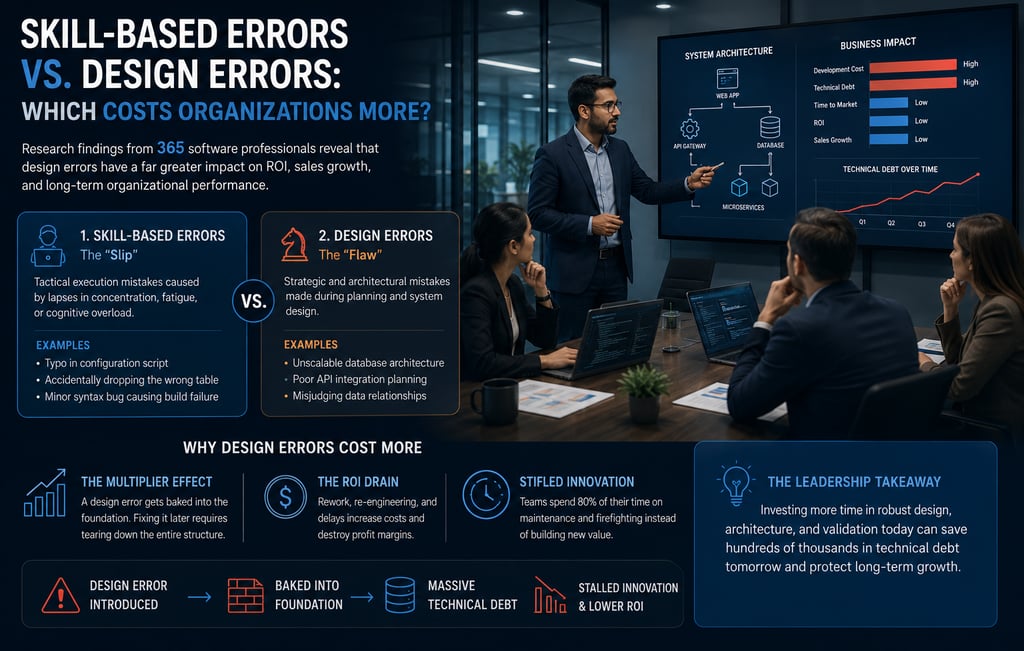
1. Skill-Based Errors (The "Slip")
These are tactical execution mistakes. These occur when a highly capable software engineer or DBA has direct experience of what to do. Still, a slip occurs because their attention wanders briefly, they are tired, or they are cognitively overloaded.
For instance, a typo in a configuration script, accidentally dropping the wrong table during a routine database migration, or a minor syntax error that causes builds to fail.
2. Design Errors (The "Flaw")
But these are high-level conceptual blunders made well before any code has been entered into a text editor. When they are identified during the planning, system modeling, and architectural phases, they might be what you call flaws in the fundamental logic of how data flows or how systems interact.
Scenarios like choosing a non-scalable database architecture for a high-volume app, failing to plan for future API integrations, or misjudging data relationship dependencies.
What the Data Reveals: The True Cost of a Flaw
This study showed that Design Errors are even worse than skill-based errors, which occur almost daily and cause immediate frustration.
Does this explain why design flaws are more costly for organizations? And the answer boils down to three big factors:
The Multiplier: A skill-specific coding bug can often be corrected in minutes or hours once diagnosed. However, a design mistake is deeply embedded in the very algorithms that form the basis of its software. Hundreds of hours of code have been layered on top of it by the time it's discovered in production. The only solution is to demolish the entire building.
The ROI Drain: Survey data from 365 surveyed IT export professionals revealed a strong connection between high design error rate and large drops in project ROI. If it requires frequent re-engineering of the system architecture after launch, you render your development costs extremely high, and your initial profits are wiped out in no time.
Mechanical Engineering Stagnation and Sales Inhibition: When the core architecture of a software company is broken, engineering teams spend 80% of their time "fire-fighting" and maintaining legacy systems instead of building new features. This technical debt traps the product roadmap, allowing competitors to move faster while directly delaying the firm's sales growth.
[Design Error Introduced] ➔ [Baked into Foundation] ➔ [Massive Technical Debt] ➔ [Stalled Innovation & Lower ROI]
The Leadership Takeaway
For a technology leader, the data are unambiguous: investing in speed over architecture is a financial mirage.
Though skill-based mistakes should be reduced by automated testing, peer reviews, and avoiding human overload, your biggest impact as a leader happens during system planning. If you put in two more weeks of strong architectural design, schema validation, and planning, it might save your organization hundreds of thousands in technical debt that accumulates later on.
In the next post, we'll find out how human errors in Quality Assurance (Testing) & Maintenance can damage customer satisfaction and consumer confidence to absolute dust.
This article is based on research published in:
Paramanantham, S., et al. (2022).
International Journal of Information Systems and Social Change (IJISSC).