Technology Leadership • Digital Transformation • Strategic IT Insights

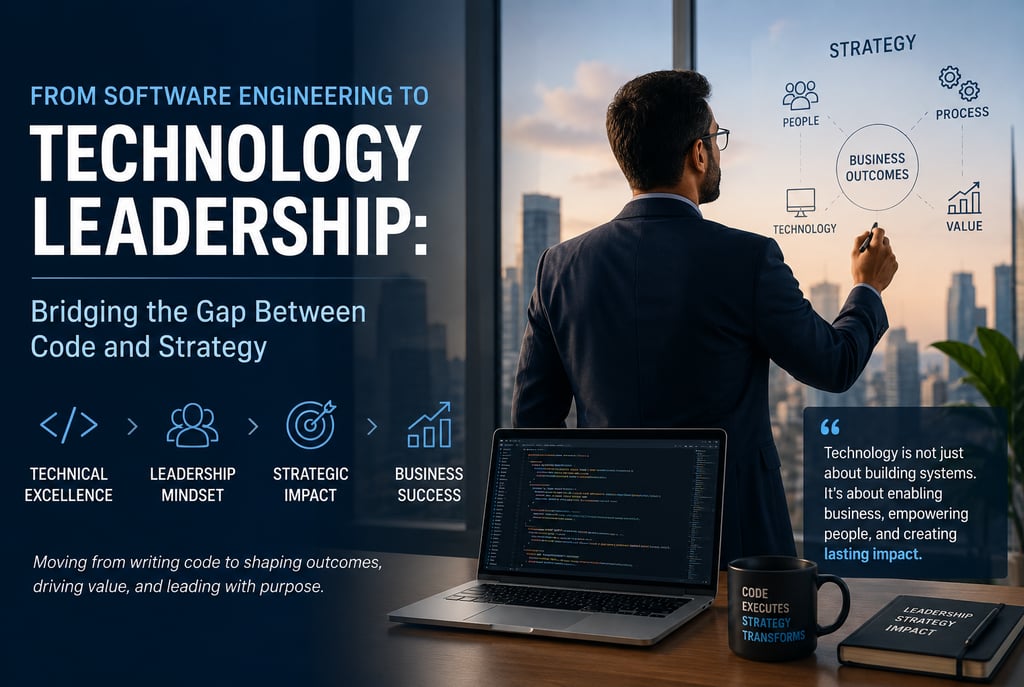
From Software Engineering to IT Leadership
Insights into the journey from software engineering to technology leadership, highlighting the shift from technical problem-solving to strategic decision-making and business impact.
INSIGHTS
By Shampave Paramanantham | Associate Tech Lead | MBA | DBA Researcher | fCMgr (CMI) | MBCS
6/9/20263 min read
Executive Summary
Moving from software engineering to technology leadership is not just a sideways promotion; it is an eye of the beholder. Success is no longer defined solely by technical execution, system performance, or successful deployments. Technology leaders are expected to understand how technology decisions influence organizational strategy, operational performance, customer experience, and business outcomes. After all, rather than focusing solely on technology decisions, the expectation is that tech leaders understand how those decisions affect organizational strategy, operational performance, customer experience, and ultimately business results.
Although technical expertise still counts, leadership requires a deeper understanding of how technology delivers value across the organization.
Looking Beyond the Code
In the early days of your software engineering career, success is often reduced to technical outputs. It is where features are implemented, defects are fixed, database performance is tuned, and system upkeep is performed. These activities are fundamental to organizational success, laying a strong technical foundation.
The reality, however, is that technology does not exist in a vacuum, and as professionals move up the ranks into leadership positions, this becomes clearer.
A technically elegant solution that does not enable business goals often drives little value. Furthermore, performance problems, architectural failures, or late deliveries lead to business challenges, including customer change flows, revenue interruptions, and reduced organizational productivity.
That moment is when you cross the line from software engineer to technology leader.
Three Key Mindset Shifts
From Outputs to Outcomes
Software engineers tend to latch onto outputs: completed tasks, delivered features, or resolved technical issues.
Technology leaders focus on outcomes.
Questions shift from:
Was the feature delivered?
Was the issue fixed?
to:
Was the customer experience better after this solution?
Did it support business objectives?
Did it improve the organization's performance?
Trends of technology leadership need to be linked to tangible business results.
From Managing Systems to Managing Risk
Organizational risk must be at the center of technology leaders' evaluation of technical decisions.
A security vulnerability, design flaw, or operational failure is not just a technical issue. It can affect:
customer trust,
business continuity,
regulatory compliance,
organizational reputation,
and financial performance.
Good leaders get the message that the governance of technology is as much a business issue as a technical one.
From Coding to Communication
Communication is an essential leadership skill.
Technology leaders are often the bridge between technical teams and business stakeholders. They also make difficult technical concepts accessible, enabling decision-makers to act.
The ability to effectively communicate the risks, opportunities, and strategic priorities of technology becomes more valuable than limited technical expertise.
Leadership, Human Error, and Organizational Performance
The research I did on human error in software development organizations was motivated, among other things, by the transition from being an engineer to becoming a leader who leads the engineers.
While going through the various stages of my technical career, I saw those human errors as operational pain points, bugs, deployment failures, misunderstood requirements, or missed testing.
But from a leadership standpoint, all these issues are just the tip of the iceberg.
They indicate problems in communication, processes, culture, leadership, and decision-making that underlie this human error.
It was this insight that prompted me to research 365 software professionals and seasoned project managers to understand how human fallibility affects firm outcomes.
The results reinforced a fundamental challenge in technology: technology problems are rarely purely technical. Often, they are intimately tied to leadership, management practices, and organizational systems.
Closing Thoughts
Moving away from tech is not the journey when moving from software engineering to technology leadership. It's about broadening the lens of how we see technology.
Exceptional technology leaders do care about technical excellence, that is a given, but they also understand strategy and communication, they appreciate performance at the organizational level, and creating value in business.
The best leaders are those who can successfully connect the dots between code and strategy.
In the coming articles, I will dive into how leadership, human factors, and technology management converge with software delivery to enable effective organizational outcomes.